Editorial Serif Anchor
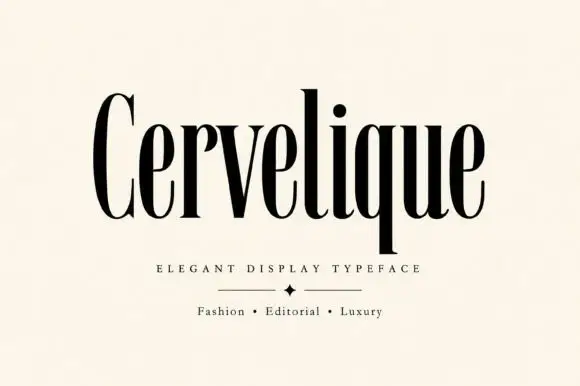
Oriel + Cervelique
Anchors Oriel's fluid strokes with crisp Roman proportions on wedding suites, headers and packaging.
Inspect Cervelique specimenDisclosure: MakerFileHub may earn a commission from qualifying purchases via paid links on this page. How our links work.
Airy open-loop minimalist monoline signature script (Multilingual)
Oriel is an airy, minimalist monoline signature script featuring wide open oval 'O' loops, unhurried rhythm, and full multilingual support.
Paid link
Get this fontProject & layout blueprintsAt-a-glance maker compatibility
Weld or Unite overlapping script joins into one continuous vector path before sending to the blade.
Visual anatomy & craft review
Oriel is an airy monoline signature script with wide open oval O loops, an unhurried even rhythm and a very light optical weight, drawn to sit quietly on editorial stock rather than to shout. Because the stroke never thickens, it plots, foils and prints predictably, and because the loops stay open, the face reads at 14 mm even when printed in a pale ink. It carries multilingual character support, so a name in another script keeps the same airy construction. It suits quiet branding, place cards and watermarks, and it looks wrong at poster scale where its lightness becomes timid.
Airy-open-loop · Minimalist-signature · Editorial
Two-font hierarchy recipes
Tested contrast partners — pairing Oriel with grounded secondary typography.
Oriel + Cervelique
Anchors Oriel's fluid strokes with crisp Roman proportions on wedding suites, headers and packaging.
Inspect Cervelique specimen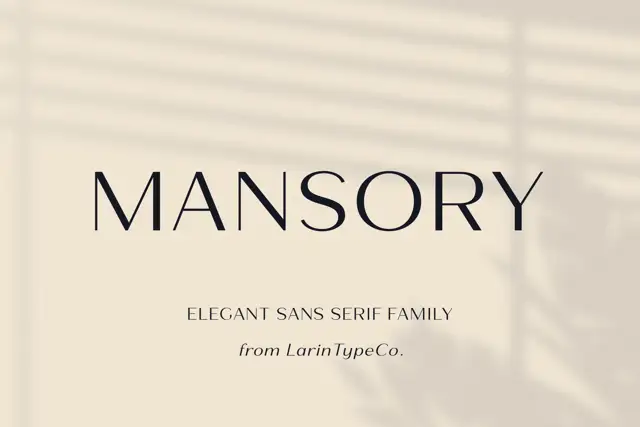
Oriel + Mansory
Keeps small-scale dates, URLs, nutrition facts and care instructions crisp and legible below script titles.
Inspect Mansory specimenPractical applications
Concrete hierarchy, scale and production guidance tailored to Oriel’s stroke geometry.
A light monoline signature reads as a maker's mark rather than a label, which is what a small studio wants on a garment tag. Open loops survive being printed at 14 mm on a woven tag where a shaded script would fill.
Hierarchy & layout recipe
Tag 40 x 80 mm, word 9 mm, 4 mm around the eyelet, 3 mm trim. Studio mark 60 mm wide on a card, 8 mm word. Watermark 1200 px wide at 30 percent opacity on a 4000 px image.
Pre-production check
Woven tags are made from thread and any stroke under 1 mm converts to a single yarn that disappears. Request a woven proof at final size, and if the monoline breaks, switch that tag to a printed label.
An airy script keeps a minimalist wedding suite calm, and the open loops let names sit without crowding the generous white space the design depends on. Monoline weight prints cleanly on textured linen stock.
Hierarchy & layout recipe
Menu 120 x 210 mm, header 18 mm, dishes 9/13 pt, 18 mm margins. Place card 90 x 50 mm, name 11 mm, table 4 mm. Vow book 110 x 160 mm, cover 20 mm, 15 mm margins.
Pre-production check
Textured linen stock breaks a monoline into a dotted line if the ink is thin. Specify a slightly heavier ink film or a smooth-finish linen, and check one menu at reading distance before printing.
Light script suits a spring workshop invitation that should feel unhurried, and open counters keep it legible on a small card. Uniform weight lets the same file be used as a label and as a sign-off.
Hierarchy & layout recipe
Invitation A6, greeting 16 mm, details 4.5 mm on 6 mm leading, 12 mm margins. Seed-swap card 105 x 148 mm, heading 14 mm, list 7/10 pt. Label 60 x 40 mm, word 8 mm, 4 mm die margin.
Pre-production check
A6 invitations are often printed two-up and trimmed, and a script crossing the trim line gets cut through a loop. Keep 8 mm clear of every trim edge and check one finished card against the bleed.
Technical & licence verification
Confirm included OTF/TTF/WOFF formats, full glyph tables and licence coverage on the live store page before batch production.
Closest visual alternatives
Matched across letterform anatomy, stroke behaviour and craft applications.
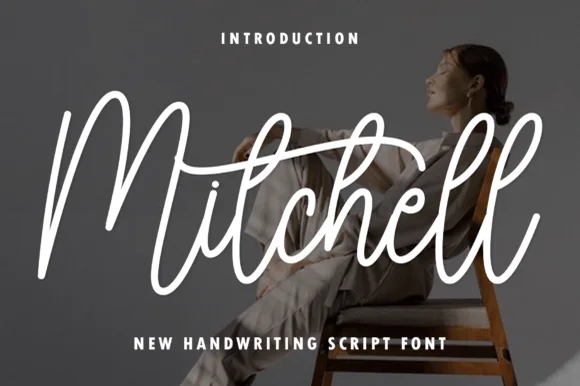
Tall upright brush-pen signature calligraphy script
Mitchell is a stylish, tall-looped brush-signature script pairing high editorial ascenders ('M', 't', 'h', 'l') with smooth, vinyl-friendly stroke weight.
Ideas for this font
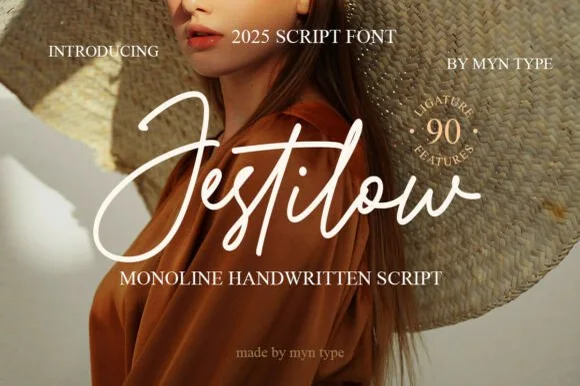
Flowing signature monoline script with 90 ligature features
Jestilow is an expressive monoline signature script packed with 90 custom ligatures, soaring t-crossbars, and sweeping initial loops.
Ideas for this font
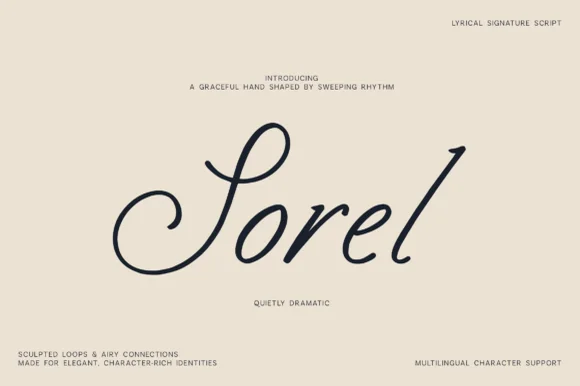
Lyrical monoline-shaded calligraphic signature script
Sorel is a poised, slanted lyrical signature script defined by an expansive double-curled S-loop and crisp high-rising ascenders.
Ideas for this font
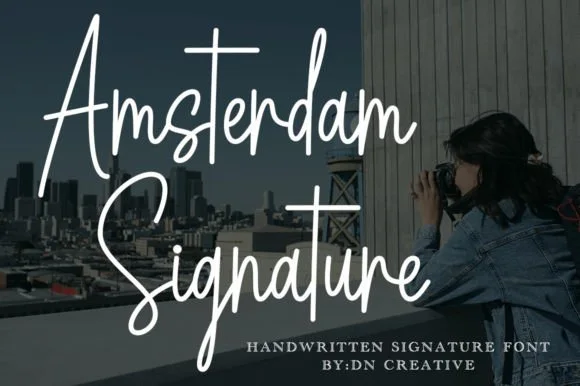
Tall monoline signature script
Amsterdam Signature is a slender, upright monoline cursive with dramatic peaked capitals and sweeping t-crossbars.
Ideas for this font
Same independent foundry
Allow optional Google Analytics to measure visits and catalogue actions. Your search words and notes are not included. Privacy & storage