Neutral Sans Workhorse
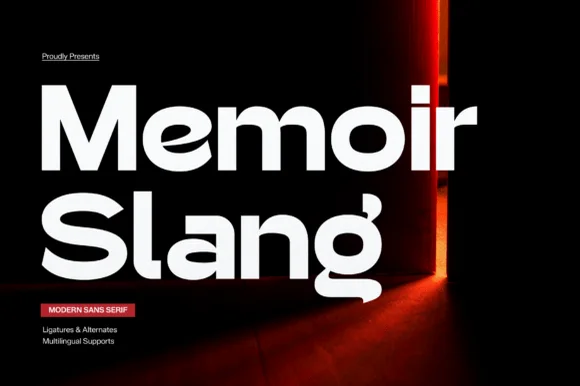
Dotstitch + Memoir Slang
Lets Dotstitch own the focal silhouette while handling secondary copy, sizing and subheads cleanly.
Inspect Memoir Slang specimenDisclosure: MakerFileHub may earn a commission from qualifying purchases via paid links on this page. How our links work.
Running-stitch embroidery & dashed-pen monoline font (OTF & TTF)
Dotstitch is a charming monoline dashed-stitch font mimicking hand-sewn embroidery running stitches and scissor cut-lines (OTF & TTF).
Paid link
Get this fontProject & layout blueprintsAt-a-glance maker compatibility
Sturdy stroke walls and open counters weed cleanly on adhesive vinyl, HTV apparel film, and cut cardstock.
Visual anatomy & craft review
Dotstitch is a monoline alphabet drawn as a running stitch: each stroke is broken into even dashes with rounded ends, so the letterforms read as thread sewn through fabric rather than as an outline drawn on top of it. Because the weight never varies, the face scales predictably for cutting and plotting, and the dash rhythm gives clear entry points for anyone following the line. Lowercase and uppercase differ enough to be set as a pair, which is unusual for a novelty stitched face. It carries small labels well and pulls apart in large sizes where the gaps become part of the drawing.
Running-stitch · Hand-sewn · Tracing-ready
Two-font hierarchy recipes
Tested contrast partners — pairing Dotstitch with grounded secondary typography.
Dotstitch + Memoir Slang
Lets Dotstitch own the focal silhouette while handling secondary copy, sizing and subheads cleanly.
Inspect Memoir Slang specimen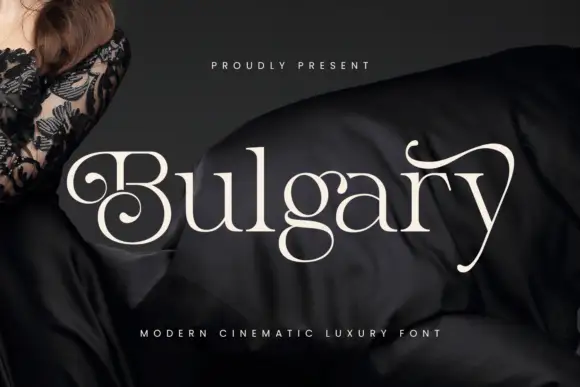
Dotstitch + Bulgary
Grounds bold display lettering with classic typographic authority on posters, badges and apparel.
Inspect Bulgary specimenPractical applications
Concrete hierarchy, scale and production guidance tailored to Dotstitch’s stroke geometry.
Dashed monoline strokes give a child an obvious path to follow and an obvious place to stop, which is why the pattern works on a tracing card. Uniform weight means a classroom printer reproduces it without the ink spread that thickens playful outlines on cheap copier paper.
Hierarchy & layout recipe
Worksheet A4 portrait, 15 mm margins, letter height 25 mm on a 32 mm baseline grid, cutting line 1 mm dash outside each shape. Tracing card A5, name 30 mm in 40 percent grey, three repetitions. Bunting triangles 150 x 190 mm, one letter at 90 mm, 10 mm stitching guide inside the edge.
Pre-production check
Confirm the ink: a 40 percent grey dashed line disappears on a laser printer at 300 dpi when the dash is under 0.6 mm. Print one sheet on the school's actual machine and measure the lightest dash, then thicken the stroke if needed rather than darkening the whole layout.
A stitched monoline reads as instruction as well as decoration, so a craft retailer can use it to signal that a kit is genuinely sewn by hand. The even dashes hold at tag scale where a textured display face would fill in, and the face pairs naturally with a plain sans for the practical copy.
Hierarchy & layout recipe
Hangtag 50 x 90 mm, word 9 mm cap-height, 4 mm around the hole, 3 mm trim margin. Kit box 250 x 180 x 60 mm, word 22 mm on the lid, contents list 7/9 pt neutral sans. Logo accent under a serif wordmark, 6 mm cap-height, tracking +60 units, aligned to a 3 mm baseline offset.
Pre-production check
Hangtags are punched, not die-cut, and a 9 mm dashed word sitting 4 mm from the hole reads as part of the hole once the string passes through. Move it to 6 mm clear and check a strung sample against a printed tag.
The running-stitch line is the same mark made by a needle, so a valentine made in felt reads as genuinely hand-sewn rather than printed to look homespun. Dashes also give a legitimate cut guide for a child-safe ornament kit without adding a second artwork.
Hierarchy & layout recipe
Ornament heart 90 x 90 mm, two 1.5 mm stitch holes per dash position, word 12 mm cap-height sewn in six-strand floss. Classroom valentine 75 x 100 mm, name 8 mm, message 4 mm in a plain text face. Card 105 x 148 mm with 6 mm ribbon slot at the fold, word 10 mm.
Pre-production check
At 12 mm cap-height the dash gaps drop below 1 mm and a hand needle cannot follow them. Increase ornament lettering to 18 mm or swap the floss line for a fuller backstitch; verify on actual felt before printing the kit instructions.
Technical & licence verification
Confirm included OTF/TTF/WOFF formats, full glyph tables and licence coverage on the live store page before batch production.
Closest visual alternatives
Matched across letterform anatomy, stroke behaviour and craft applications.
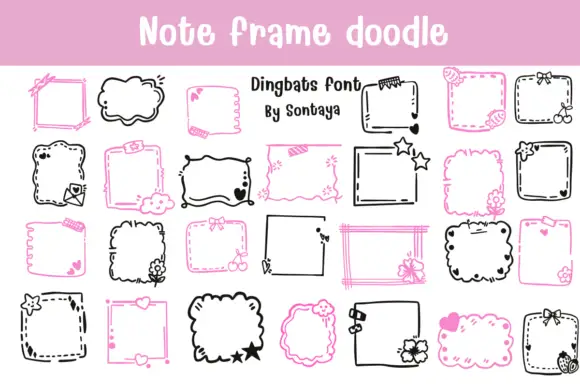
Note-frame dingbat set
Note Frame Doodle is a dingbat sheet on a pink band and white ground: many hand-drawn note frames in black and pink, some straight and ruled, some cloud-like with scalloped edges, decorated with small flowers, bows, stars and hearts, with a lined title at the top and a credit in the middle.
Ideas for this font
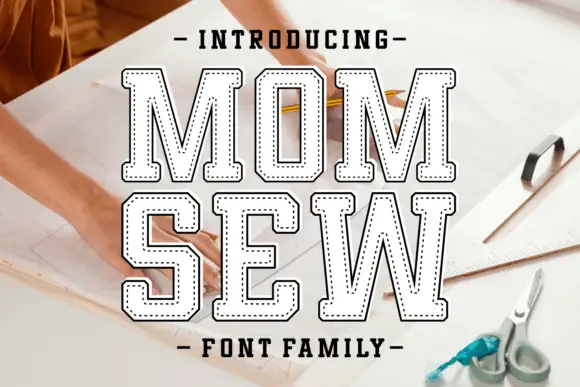
Hollow collegiate slab with stitch line
Mom Sew is a hollow collegiate slab in white on a photograph of a sewing table: heavy caps drawn as a contour with no fill, and inside each letter a dotted line that follows the shape like a running stitch, with tracked caps above and below.
Ideas for this font
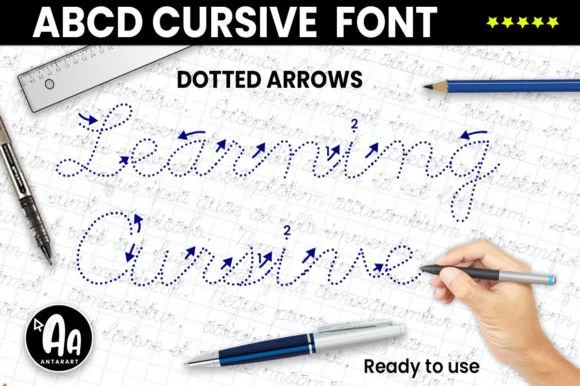
Dotted cursive handwriting-worksheet font with numbered stroke arrows!
Abcd Cursive Dotted Arrows is a dedicated teacher worksheet font building dotted cursive letters complete with numbered directional stroke-order arrows ('1→', '2→')!
Ideas for this font
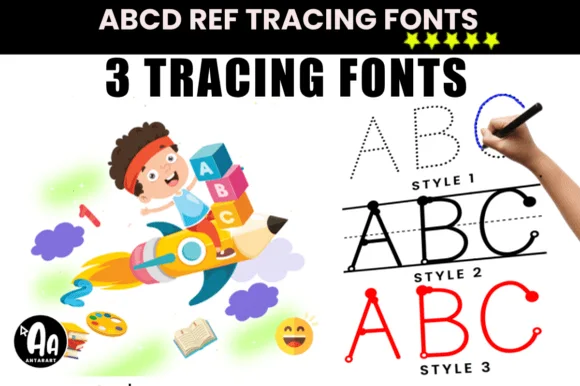
3-style dotted & ruled handwriting tracing pack
Abcd Ref Tracing Lined offers three purpose-built handwriting practice styles, dotted, lined and start-dot, for teachers, homeschoolers and KDP creators, where students trace dashed outlines along primary penmanship rules or follow starting dots typed directly in a word processor.
Ideas for this font
Allow optional Google Analytics to measure visits and catalogue actions. Your search words and notes are not included. Privacy & storage