Neutral Sans Workhorse
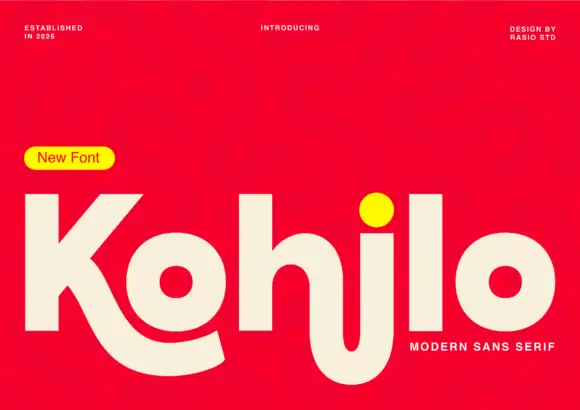
Alexander + Kohilo
Lets Alexander own the focal silhouette while handling secondary copy, sizing and subheads cleanly.
Inspect Kohilo specimenDisclosure: MakerFileHub may earn a commission from qualifying purchases via paid links on this page. How our links work.
Botanical & entomology engraved naturalist serif (OTF & TTF)
Alexander is an intricate vintage naturalist's display serif filling hollowed Roman capitals with fine-line butterflies, honeybees, and wildflowers (OTF & TTF)!
Paid link
Get this fontProject & layout blueprintsAt-a-glance maker compatibility
Sturdy stroke walls and open counters weed cleanly on adhesive vinyl, HTV apparel film, and cut cardstock.
Visual anatomy & craft review
Alexander is a naturalist's display serif whose hollowed Roman capitals are filled with fine botanical and entomological line work — butterflies, honeybees, wildflowers — so each letter reads as a specimen plate rather than a letter with an ornament. The interior detail is delicate, so the face needs roughly 40 mm before the insects read as drawn rather than as dirt, and the outline is what holds the shape at distance. It is a title and plate face, best in one ink on laid or cream stock, and it should never be used below about 18 mm.
Naturalist-engraving · Butterfly-floral-inlay · Herbarium
Two-font hierarchy recipes
Tested contrast partners — pairing Alexander with grounded secondary typography.
Alexander + Kohilo
Lets Alexander own the focal silhouette while handling secondary copy, sizing and subheads cleanly.
Inspect Kohilo specimen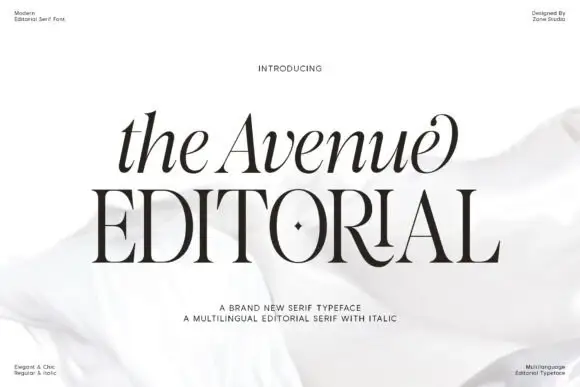
Alexander + The Avenue Editorial
Grounds bold display lettering with classic typographic authority on posters, badges and apparel.
Inspect The Avenue Editorial specimenPractical applications
Concrete hierarchy, scale and production guidance tailored to Alexander’s stroke geometry.
Naturalist interiors give a botanical brand the credibility of a nineteenth-century plate without a texture overlay. The outline keeps a short name legible at 40 mm on a carton.
Hierarchy & layout recipe
Carton 60 x 130 x 30 mm, name 20 mm, legal 5.5/7.5 pt, 8 mm margins. Label 70 x 100 mm, name 16 mm, 5 mm top arc. Plate 150 x 210 mm, name 34 mm, caption 8/11 pt.
Pre-production check
Fine line work under 0.2 mm fills on uncoated carton stock and the insects vanish. Print on coated board or a smooth laid sheet, and check one 1:1 proof before the run.
Specimen-plate lettering reads as an heirloom card rather than a modern greeting, which suits a formal thank-you. The single ink keeps the interior detail clean on a small plate.
Hierarchy & layout recipe
Card 120 x 170 mm, greeting 28 mm, message 8/12 pt, 14 mm margins. Plate 100 x 70 mm, name 20 mm, owner line 8 pt. Bookplate 90 x 60 mm, initials 18 mm, rule 1 pt.
Pre-production check
Bookplates are written on by the owner, and a botanical interior at 18 mm leaves no clean space for a signature. Keep 10 mm clear beneath the initials, and check one written sample before printing.
Specimen interiors read as a period plate, which is what a natural-history title wants on a shelf. One ink holds the whole ornament without a second colour.
Hierarchy & layout recipe
Cover 170 x 240 mm, title 60 mm, author 15 pt, 18 mm margins. Plate 210 x 297 mm, name 46 mm, caption 9/12 pt, 20 mm margins. Journal 145 x 210 mm, cover 30 mm.
Pre-production check
Book covers are reproduced at thumbnail size online, where interior line work greys out. Check the title at 120 px, and consider a solid-lettered thumbnail while keeping the specimen cut for the printed cover.
Technical & licence verification
Confirm included OTF/TTF/WOFF formats, full glyph tables and licence coverage on the live store page before batch production.
Closest visual alternatives
Matched across letterform anatomy, stroke behaviour and craft applications.
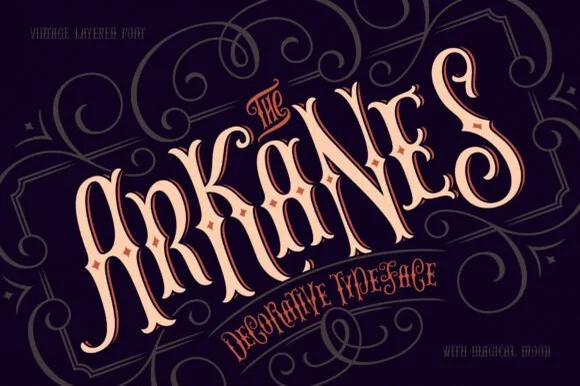
Layered Victorian decorative lettering with ornamental inner lines
The Arkanes is a decorative Victorian alphabet in which the stems carry drawn ornament, the letters arch along a curve and two offset layers sit behind each word, so a title reads as a hand-painted fairground sign.
Ideas for this font
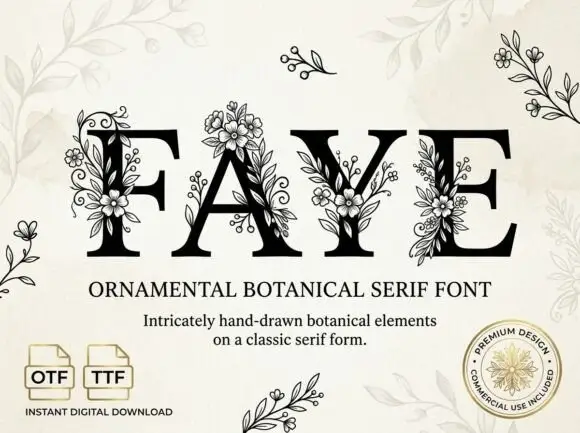
Large contrast serif capitals crossed by fine outlined flower and leaf clusters
Faye places black capitals on pale cream, where large fine-lined flowers overlap the F stem and the A apex, leafy sprigs and small buds cross the Y and E, and narrow curled tendrils climb between the letters while standalone sprigs sit around the page.
Ideas for this font
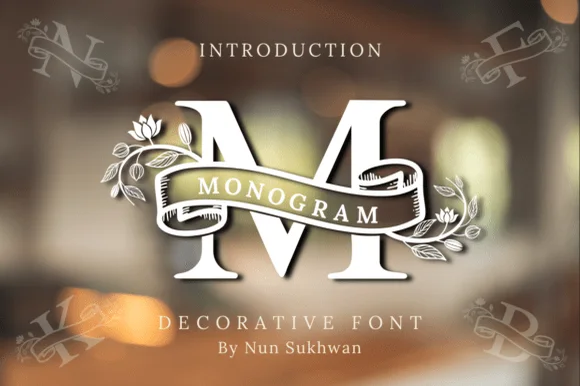
Ribbon-banner floral serif monogram
Amorette Monogram wraps classically built serif initials in a curved ribbon scroll and blooming botanical vines, and the corner specimens show N, F, K and B each carrying their own banner and floral detailing around bold structural stems.
Ideas for this font
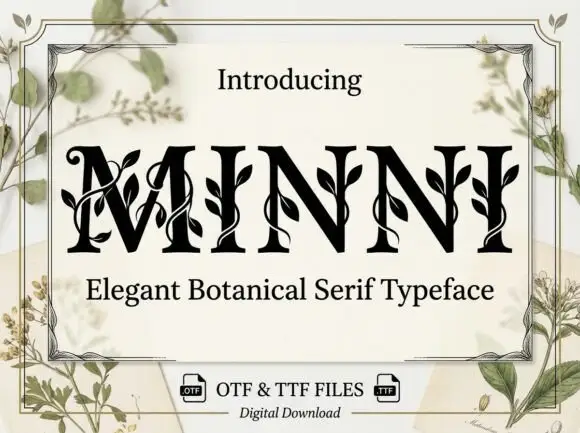
Botanical ornamented serif
Minni is a botanical serif in black on cream: high-contrast caps whose stems sprout leaves and curling vines, sharp serifs and a narrow waist, with a light botanical frame and small file badges at the foot.
Ideas for this font
Same independent foundry
Allow optional Google Analytics to measure visits and catalogue actions. Your search words and notes are not included. Privacy & storage