Neutral Sans Workhorse

Trace Me Please + Borsen
Lets Trace Me Please own the focal silhouette while handling secondary copy, sizing and subheads cleanly.
Inspect Borsen specimenDisclosure: MakerFileHub may earn a commission from qualifying purchases via paid links on this page. How our links work.
Dashed tracing-letter face
Trace Me Please is a dashed tracing face in grey on a white practice sheet: fine dashed paths in mixed case drawn on ruled guides with a dotted midline, surrounded by flat school illustrations of pencils, crayons and a binder, with a caption bar at the foot.
Paid link
Get this fontProject & layout blueprintsAt-a-glance maker compatibility
Sturdy stroke walls and open counters weed cleanly on adhesive vinyl, HTV apparel film, and cut cardstock.
Visual anatomy & craft review
This is a teaching face rather than a decorative one, and the plate shows the intended use: the letters are dashed outlines that sit on a three-line guide, so a child can trace them, and the strokes are thin enough that a pencil line stays inside. That construction sets a size floor — the letters need to be large enough for a pencil to follow — and the guides are part of the layout rather than the font. The flat stationery around the sheet is staging that names the audience. Because the face is a tracing outline, it is not meant for headings or body copy, and the plate is honest about that by showing two short words at practice size. It suits worksheets, name cards and classroom signs.
Decorative, dashed, learning, handwriting
Two-font hierarchy recipes
Tested contrast partners — pairing Trace Me Please with grounded secondary typography.
Trace Me Please + Borsen
Lets Trace Me Please own the focal silhouette while handling secondary copy, sizing and subheads cleanly.
Inspect Borsen specimen
Trace Me Please + Augler
Grounds bold display lettering with classic typographic authority on posters, badges and apparel.
Inspect Augler specimenPractical applications
Concrete hierarchy, scale and production guidance tailored to Trace Me Please’s stroke geometry.
A dashed tracing face saves a teacher from drawing guides, and the thin path keeps a pencil inside the stroke. The teacher saves the drawing of the guides.
Hierarchy & layout recipe
A4 sheet: the practice word at 60 mm cap height on a 12 mm guide, the instructions in a 12 pt sans, and a 20 mm name field. Keep 15 mm margins and print one colour on bond paper.
Pre-production check
Check the A4 at 60 mm, where a dashed path can print too faint; keep the line above 0.3 mm. Confirm the word fits between the guides and that the sheet photocopies legibly in greyscale.
A tracing name card gives a child something to do at the table and doubles as a place marker. A party table keeps a child busy without a second purchase.
Hierarchy & layout recipe
Print 90 by 60 mm cards folded to a tent: the name at 26 mm cap height on a 8 mm guide, the table note at 9 pt, and one colour on a white card. Leave 8 mm above the fold for the crease.
Pre-production check
Check the 26 mm name on a tent card, where the guide can crowd the fold; keep 8 mm clear. Confirm the card stands at the table and that the dashed line reads under a party light.
A dashed face signals teaching at a glance, which suits a tutoring business that needs a window readable to parents. It reads in daylight.
Hierarchy & layout recipe
Cut 700 by 300 mm vinyl: the name at 100 mm cap height, the hours in a 20 mm sans, and a 3 mm path. Keep 22 mm margins and apply to a clean pane. Keep 10 mm clear at the foot.
Pre-production check
Check the cut at 100 mm, where a 3 mm dashed path can tear on weeding; use a solid cut face instead. Confirm the 20 mm hours read at two metres and that the guides stay level.
Technical & licence verification
Confirm included OTF/TTF/WOFF formats, full glyph tables and licence coverage on the live store page before batch production.
Closest visual alternatives
Matched across letterform anatomy, stroke behaviour and craft applications.
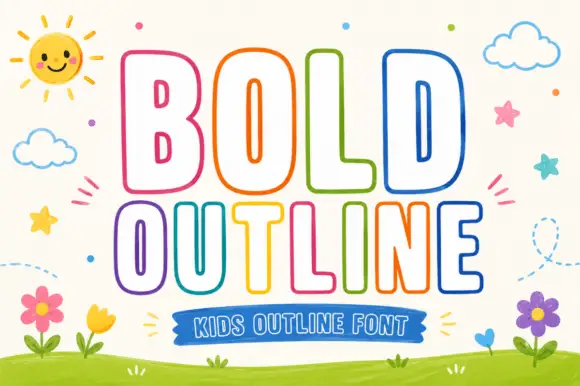
Rounded outline capitals
Bold Outline shows tall rounded capitals traced by a thin coloured contour on a pale field, where the B keeps small narrow counters while the L and D leave broad white interiors, and the letter widths change across the two rows so the second word runs wider than the first.
Ideas for this font
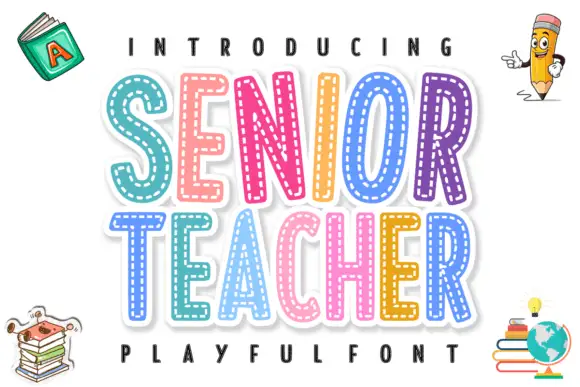
Layered stitched capitals in colour
Senior Teacher is a layered decorative display: fat capitals with a thick white outline and a dashed stitched line inside each letter, each one in a different bright colour, with drawn school objects around them.
Ideas for this font
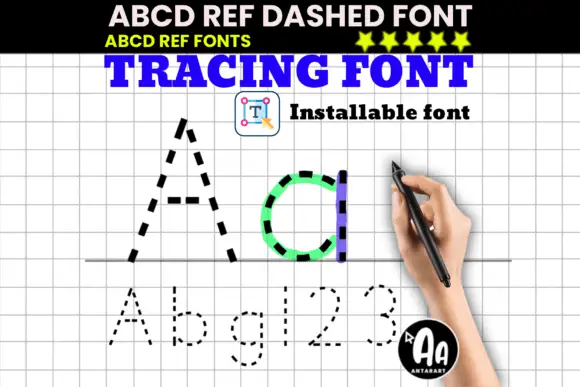
Dashed upright letter paths shown in large A and d with smaller letters and numerals
ABCD Ref Dashed and Dotted are tracing faces: the same letterforms drawn as a dashed outline for tracing and as a dotted form for dot-to-dot practice, meant to sit on ruled paper for handwriting drills.
Ideas for this font
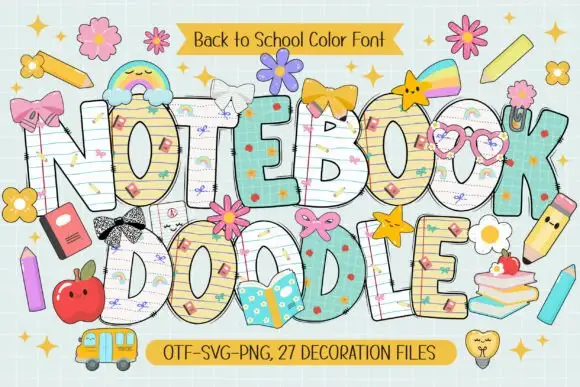
School-paper doodle colour display
Notebook Doodle is a colour display on a pale study scene: fat capitals filled with ruled paper, graph paper and star patterns, outlined in dark ink, decorated with bows, flower clips, pencils and stickers, with two ribbons that name the format list and the count of decoration files.
Ideas for this font
Allow optional Google Analytics to measure visits and catalogue actions. Your search words and notes are not included. Privacy & storage